
حديثاً, we received on-site feedback photos from a customer, frozen food palletizing for 2.5kg boxes of frozen meat bun. In the images, our dual-station column-type rotating palletizer is operating efficiently in a cold‑storage environment. Given such freezing conditions, why choose a column-type design over an articulated robot?
With the explosive growth of the frozen food industry—especially quick-frozen products like the “2.5kg frozen meat bun”—high output, frequent handling, and harsh operating environments are the norm.
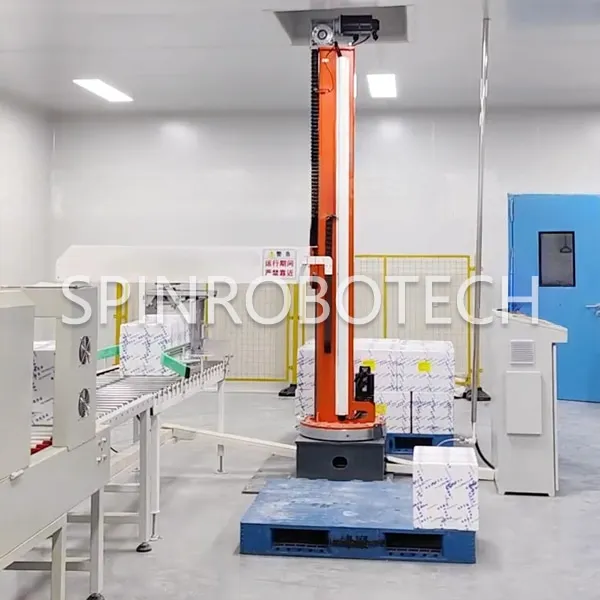
س1: What makes the cold‑storage environment for frozen meat buns so “special”? What challenges does it pose to palletizing equipment?
أ: As seen in the on‑site photos, this is a typical high‑cleanliness cold storage / low‑temperature workshop.
Extremely low temperatures: Usually between –18°C and –25°C.
High humidity and condensation: Alternating cold and warm air easily causes frost and condensation on equipment surfaces.
قيود المساحة: Cold storage is expensive to build—every square foot counts, so the equipment footprint must be minimal.
Packaging brittleness: Frozen meat bun packaging (cartons or film‑wrapped packs) becomes brittle at low temperatures. Palletizing motions must be gentle and precise; otherwise, packaging breakage or product deformation from pressure is highly likely.
Q2: Why do we strongly recommend a “column‑type” structure instead of a traditional articulated robotic arm?
أ: In freezing environments, stability and cold resistance come first.
Fewer failure points: Articulated arms have multiple rotating joints. At low temperatures, grease tends to solidify, and the complex reducers are easily damaged in the high‑humidity cold store. In contrast, the column‑type design is simple in structure, with moving parts concentrated mainly in the top motor and bottom rotating base—drastically reducing failure rates. This is ideal for cold storage, where “frequent human entry for maintenance” is inconvenient.
Extreme space savings: The palletizer works between the conveyor belt and the pallet area. The column palletizer occupies only about one‑third of the footprint of an articulated arm. With a fixed base and vertical column rise, it makes perfect use of the cold storage’s vertical height.
Top‑mounted drive design: The electrical components are placed on top of the column, effectively protecting them from ice water and condensation splashes on the ground floor, thereby extending the life of electrical parts.
س3: For the “2.5kg light load” و “food‑grade cleanliness,” what specific optimizations does this palletizer offer?
أ: High speed and flexible gripping: Although 2.5kg is light, frozen food palletizing demands speed. Our column rotating palletizer has a fast rotation speed and, paired with customized anti‑freeze, non‑slip grippers, completes picking and placing in very short cycle times.
Anti‑condensation treatment: For the cold‑store environment, we apply special low‑temperature grease to key guide rails, bearings, and drive chains, ensuring smooth operation even at –25°C—no “freeze‑up” or jamming.
س 4: What are the advantages of a dual‑station design in a cold storage?
أ: Continuous operation without downtime: Dual stations mean that when one pallet is fully stacked, the machine can immediately switch to the other empty pallet to continue palletizing, while simultaneously alerting operators (or AGVs) to remove the full pallet. In cold storage, each entry/exit loses cold air. Dual stations reduce the time spent on frequent pallet changes, significantly increasing the customer’s single‑shift output.
Versatility: In the future, if the customer has more products of different sizes, the dual‑station control system can easily support mixed palletizing of two different pallets.
Q5: From an ROI perspective, why is it the most cost‑effective choice for frozen food plants?
أ: Compared with articulated arms, the column palletizer has lower purchase cost and shorter installation and commissioning time. For light‑weight food products like 2.5kg, you don’t need to pay the high price of an articulated arm just for “a big engine pulling a small cart.” Moreover, thanks to its simple structure, maintenance costs and spare‑parts costs in the tough cold‑store environment are very low. The cables are made of low‑temperature‑resistant, anti‑freeze materials, eliminating downtime caused by cable hardening and cracking in the cold store.
مواصفات المعلمة الأساسية (بناء على هذه السلسلة الموصى بها)
| مصدر الطاقة/الطاقة | تيار متردد 380 فولت ±/5% ثلاثي الطور وأربع أسلاك |
| متطلبات الهوائية | القابضون / تركيبات: 0.6-0.8 MPa, ≥0.3 م³/دقيقةإجمالي سعة خزان الهواء >600 ل |
| أبعاد | الارتفاع الإجمالي 3 م, نصف قطر تغطية الدوران 2.5 م, البصمة 5 × 3 م² |
| طول الكابل | 3م (من جسم الروبوت إلى خزانة التحكم) |
| حد ارتفاع المنصات | ≥1600 مم |
| النطاق القابل للتطبيق | 10-50كجم المنتجبما في ذلك: أكياس, كرتون, أوراق, كتل, أو منتجات مماثلة |
| كفاءة البليت | 400-500 دورات / ساعة (الحد الأقصى النظري) |
| استهلاك الطاقة | جسم الروبوت: 6.5 كيلوواط |
| مرجع البليت | ≥1400 × 1600 مم (بما في ذلك نمط المكدس الفعلي) |
| عنصر قابل للتخصيص | طول الذراع المتقاطع, ارتفاع العمود, طول القاعدة, القابضون الخاصة |
| ترقية المتابعة | التعرف على الرؤية, خط ناقل البليت, آلية رفع الأكياس الترددية, نظام الربط المضاد للانهيار |
Palletizing frozen meat buns is not just about speed—it’s about tolerance to harsh low‑temperature conditions and control over the customer’s costs. A simple, robust, مستقر, and cold‑resistant structure is the fundamental reason why we strongly recommend this “dual‑station column rotating palletizer” to quick‑frozen food manufacturers.