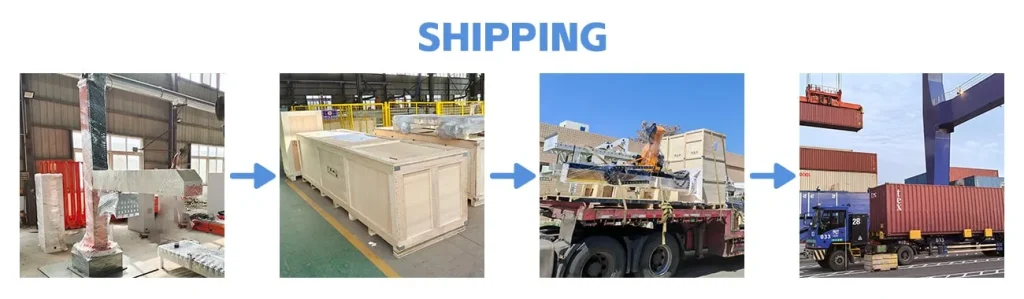
We Spin supplies three mainstream palletizing robots: cartesian robot, column palletizing robot, and articulated palletizing robots. For detailed information on the three palletizing machine types, click here: A Complete Guide to Cartesian, Column-Type, and Articulated Robots
Among the various types of industrial robots, articulated palletizing robots are undoubtedly the most common and humanoid representatives. By mimicking the structure of a human arm and incorporating multiple rotary joints (similar to the shoulder, elbow, and wrist), they achieve highly flexible, multi-angle motion. This has made them an indispensable core component in modern intelligent manufacturing and automated warehousing.
What is Articulated Palletizing Robots?
Often called robotic arms, articulated palletizing robots are a type of industrial robot featuring multiple rotary joints. Their design is inspired by the human arm, enabling them to execute complex and precise movement trajectories in three-dimensional space. With 4-6 degrees of freedom, they can reach almost any point within their working range in virtually any orientation, offering exceptional flexibility.
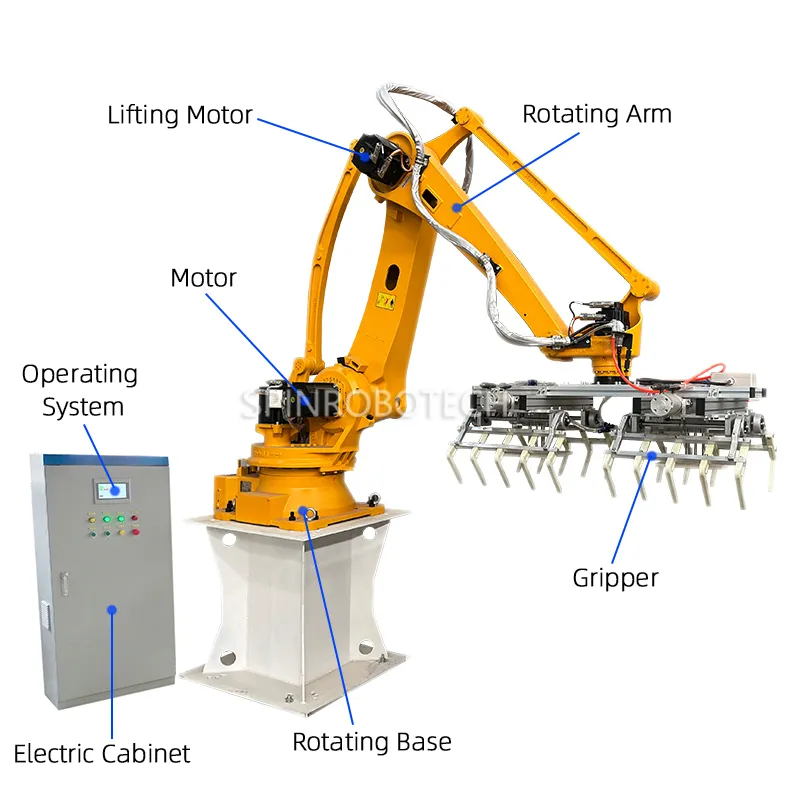
Functional Features and Technical Advantages
- High Flexibility and Broad Range of Motion
Movement Mode: Equipped with 4-6 programmable joints, supporting complex multi-angle and curved motions.
Workspace: Forms a nearly spherical three-dimensional working envelope with almost no dead angles, allowing easy navigation around equipment obstacles.
Versatility: By changing End of Arm Tooling (EOAT), they can be adapted for various industrial tasks such as palletizing, material handling, assembly, welding, and painting.
- Outstanding Performance
Payload Capacity: Covers an extremely wide range, with models available from a few kilograms to over a ton. Mainstream palletizing models typically handle payloads between 100-300 kg.
Precision and Speed: High repeatability positioning accuracy, fast motion acceleration, and short cycle times significantly enhance production efficiency.
Adaptability: Particularly suitable for flexible production lines with complex layouts, variable pallet patterns, and diverse product types.
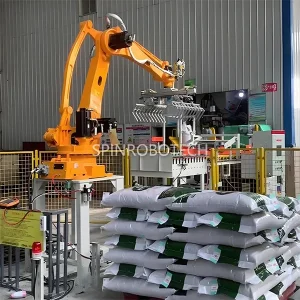
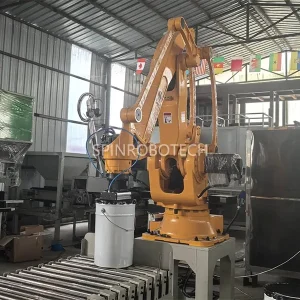
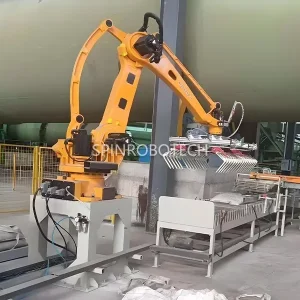
Automatic Axis Robot Palletizer Line, Articulated Robotic Arm Palletizing Packaging Line
Typical Application Scenarios
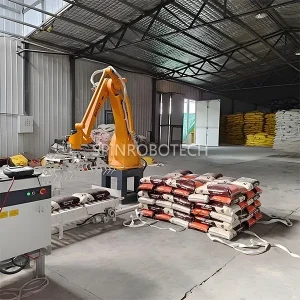
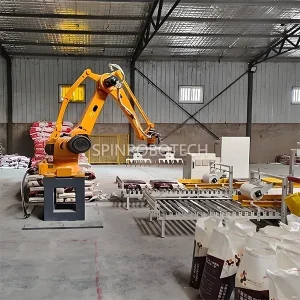
- Smart Warehousing and Logistics: Efficiently performing palletizing, depalletizing, picking, and handling tasks.
- Flexible Manufacturing Lines: Executing precision assembly in automotive and electronics manufacturing.
- Complex Environment Operations: Operating within confined spaces by navigating around obstacles, suitable for compact workshop layouts.
- High-Mix, Low-Volume Production: Meeting the demands of modern manufacturing for flexible production with quick changeover capabilities.

Key Daily Maintenance Points
Regular maintenance is crucial for ensuring the long-term stable operation of articulated robots:
- Reducer/Gearbox Maintenance (Core Component)
Regularly check lubrication status and wear to ensure smooth and precise joint transmission.
- Body Cable/Harness Inspection
Internal cables can wear due to continuous flexing; inspect periodically to prevent signal loss or short circuits.
- Motion Performance Monitoring
Monitor trajectory accuracy and repeatability; promptly troubleshoot servo motor and encoder anomalies.
- Battery Replacement (Critical Task)
Backup batteries maintain encoder and system data. Depleted batteries can lead to loss of home position; they must be replaced on schedule.
- Structural Tightening and Calibration
Check mechanical connections for looseness. Perform regular zero-point calibration and coordinate system calibration.
- External Axis Maintenance
If equipped with rails or positioning units, maintain their cleanliness and smooth operation as well.
SPIN – Professional Cartesian Robot Solution Provider
Contact us for cost-effective automation equipment and expert technical support!