
In the era of Industry 4.0, smart logistics and automated production have become key to enhancing corporate competitiveness. This article presents multiple real customer cases demonstrating the successful applications of Cartesian palletizing robots, column-type palletizing robots, and articulated robotic arms across different industries, providing reference for your automation upgrade.
For detailed information on the three palletizing machine types, click here: Automated Palletizing Solutions: A Complete Guide to Cartesian, Column-Type, and Articulated Robots
Case 1: Heavy-Duty Application of Cartesian Palletizing Robots in the Building Materials Industry
Customer Background
A large building materials manufacturer faced challenges with low efficiency in end-of-line palletizing, high labor costs, and significant risk of workplace injuries. Their product was 25kg/bag of building material powder, requiring daily palletizing of over 2,000 bags.
Solution
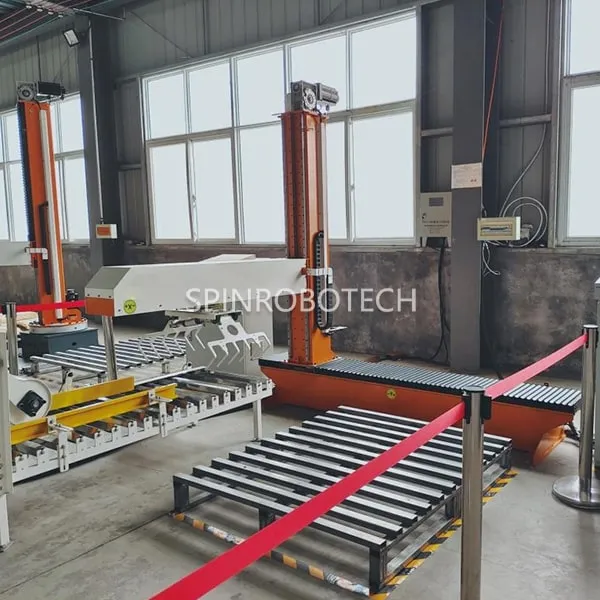
We customized a heavy-duty Cartesian palletizing system equipped with specialized grippers and a load capacity of 500kg. The system featured a dual-station design enabling continuous alternating operations.

Results
-
Productivity: Increased from 200 to 600 bags per hour
-
Labor costs: Reduced 4 manual positions, saving approximately ¥350,000 annually
-
Injury risk: Completely eliminated occupational risks associated with heavy lifting
-
ROI period: Investment payback in just 14 months
Case 2: High-Efficiency Application of Column Palletizing Robots in Beverage Industry
Customer Background
A well-known beverage company faced space constraints in a new production line, requiring a palletizing capacity of 3,000 cases per hour within a limited area, while needing seamless integration with existing production lines.
Solution
We recommended a high-speed column-type palletizing robot with a compact base requiring only 1.5m² of floor space, yet covering a working radius of 3.5 meters. The robot was equipped with a vision positioning system for automatic product specification recognition.


Results
-
Space utilization: Saved 40% of equipment footprint
-
Productivity: Consistently achieved 3,200 cases per hour
-
Flexibility: Capable of handling 4 different box specifications simultaneously
-
Reliability: Operated continuously for 6 months without failure
Case 3: Flexible Application of Articulated Robotic Arms in Food Industry
Customer Background
A premium food company with diverse product lines needed to handle palletizing tasks for over 50 different product specifications daily. Traditional automation equipment couldn’t adapt to such frequent changeover requirements.
Solution
We provided a six-axis articulated robotic arm palletizing system with 3D vision recognition and quick-change tooling system. Through advanced algorithms, the robot could automatically identify product types and call corresponding palletizing programs.


Results
-
Changeover time: Reduced from 30 minutes to 90 seconds
-
Production flexibility: Capable of handling various products from 5kg to 25kg
-
Labor reduction: Eliminated 6 positions, reducing labor costs by 50%
-
Capacity improvement: Overall productivity increased by 35%
Industry Application Summary
Based on our extensive project implementation experience, the typical application scenarios for the three main types of palletizing robots are as follows:
| Robot Type | Target Industries | Typical Applications | Efficiency Improvement |
|---|---|---|---|
| Cartesian Robots | Building Materials, Chemicals, Grain & Oil | Heavy bagged/drummed materials | 200%-300% |
| Column-Type Robots | Beverage, Food, Electronics | Boxed/cased products | 150%-250% |
| Articulated Robotic Arms | Food, Personal Care, Pharmaceuticals | Mixed production lines with multiple specifications | 120%-200% |
Technical Selection Recommendations
When selecting palletizing robots, we recommend considering the following dimensions:
-
Product characteristics: Weight, dimensions, material properties
-
Capacity requirements: Current capacity and future expansion needs
-
Space constraints: Equipment installation and operational space requirements
-
Budget range: Initial investment and long-term operating costs
-
Automation level: Existing infrastructure and automation level
Contact our solution experts today to get your customized industry automation assessment report!