
We have customized one set of food-grade palletizing line for a client, which includes a bag sewing machine, a conveyor belt, and a dual-palletizing-station column rotating food-grade palletizer. The existing product packaging and production line information is as follows:
Product name: Food-grade flour improver
Packaging form: PP woven bag
Product specification: 25 kg/bag
Product bag dimensions: 740x500x200 mm
Pallet dimensions: 1300×1100 mm
Stacking pattern: 5 pieces per layer, 8–9 layers
Total pallet height: 1600 mm
Based on the above basic information, we recommended and customized the MR-180 single column rotaty robot for the client, equipped with a customized gripper. The machine parameters are as follows:
| Parameters | |
| Power supply/Power | AC 380V±/5% three-phase four-wire |
| Pneumatic Requirements | Grippers/Fixtures: 0.6-0.8 MPa, ≥0.3 m³/min
Suction Cups: 0.6-0.8 MPa, 0.6-1.1 m³/min, Total air reservoir capacity >600 L |
| Dimensions | Overall height 3m, rotation coverage radius 2.5m
footprint 5×3 m² |
| Cable Length | 3m (from robot body to control cabinet) |
| Power | Robot body: 6.5 kW |
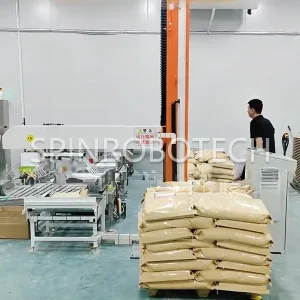
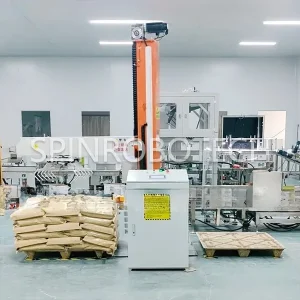
The food-grade palletizing line has been debugged and is ready for customer acceptance.
We Spin supply three mainstream palletizing robots: cartesian coordinate robots, column-type palletizer, and articulated robotic arms. For detailed information on the three palletizing machine types, click here: Automated Palletizing Solutions: A Complete Guide to Cartesian, Column-Type, and Articulated Robots
Automatic Column-type Rotary Palletizer: The Space-Saving Efficiency Experts
Column-Type Rotary Palletizing Robot, also known as a polar coordinate robot. It combines rotational and linear movements, and its structure typically consists of a base column (enabling rotation), an arm that can extend and retract vertically (enabling radial expansion and contraction), and an end effector.
Features:
-
Motion Method: Generally, comprises two types of motion:
-
Column rotation (θ-axis): The base drives the entire arm to rotate.
-
Radial extension (R-axis): The robot arm can extend forward or retract.
-
Vertical lifting (Z-axis): The end effector can move up and down.
Its motion trajectory covers any point within a cylindrical space centered on the column.
-
-
Load Capacity: Moderate load capacity, typically between that of Cartesian and articulated robots, making it suitable for medium-to-low load palletizing tasks.
-
Precision and Speed: Fast operation, smooth movement, and short cycle times.
-
Workspace: The workspace is a cylindrical sector area, striking a good balance between footprint and coverage range.
Advantages:
-
Small footprint (only one base) but large working range, offering extremely high space utilization.
-
High speed, short cycle times, and high efficiency.
-
Cost-effective, providing high value for money in suitable applications.
Typical Applications:
- Suitable for medium-to-low-speed palletizing production lines with a fan-shaped working area, compact space, and high cycle time requirements. Examples include palletizing bottled water, boxed beverages, food boxes, etc.
Typical Scenarios:
-
Food & Beverage Industry: Palletizing milk, beverage, and beer cartons; capable of operating in cold storage environments.
-
Chemical & Building Materials Industry: Handling cartons containing chemicals or powders, minimizing human contact risks.
-
Logistics & Warehousing Centers: Efficiently managing the palletizing of multi-variety, small-batch orders to improve warehouse turnover rates.
-
Automotive & Parts Industry: Used for palletizing heavy parts packed in cartons.
SPIN – Professional Palletizing & Depalletizing Robots Solution Provider
We provide one-stop service from selection and planning to after-sales support. Contact me for a customized solution based on your materials and site!