
Récemment, nous avons reçu des photos sur place du projet de palettisation de batteries de 20 kg d'un client. Many customers often hesitate between a 6-axis articulated robot and a column-type robot when planning automation upgrades. Today, using this real battery palletizing case, we’ll walk you through – in a Q&A format – why we strongly recommended this column-type rotary palletizer to this customer (and to many other battery manufacturers).
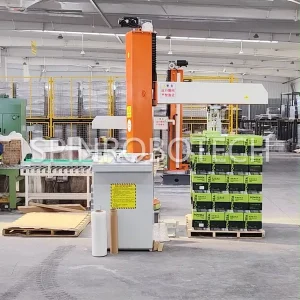
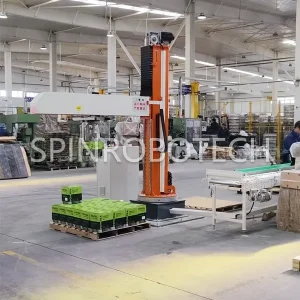
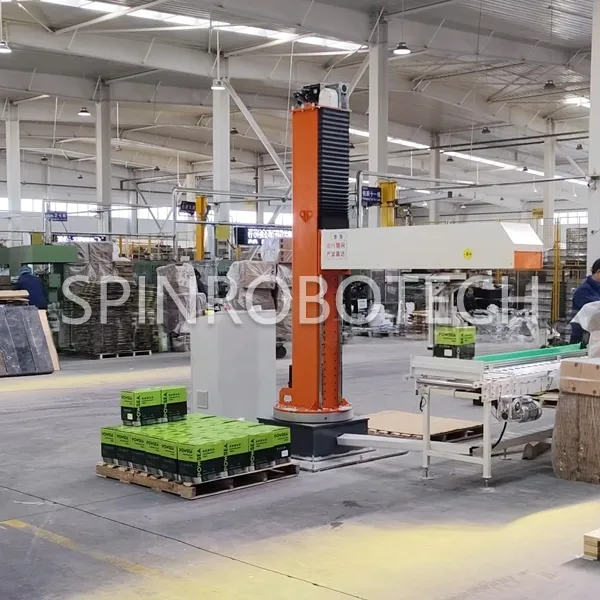
T1: The robot in the photo looks very compact. What advantages does it offer in terms of workshop layout?
UN: Minimal footprint, maximizing production space.
Compared with traditional gantry-style (truss) robots and large 6-axis articulated robots, this column-type rotary robot features a “center-post + rotating cantilever” structure. Its base is extremely compact and can be installed directly at the end of a production line.
For battery manufacturers, where factory space is at a premium, this design saves significant floor space and keeps workshop traffic smooth. It doesn’t require a gantry spanning across aisles, nor does it occupy a large swing radius like articulated robots do. It is perfectly suited for flushmount installation at line ends.
T2: For heavy lifting of 20kg batteries, can this robot’s structure maintain long-term stability and durability?
UN: Rugged and stable – built specifically for heavy-duty palletizing.
Lifting 20kg manually is highly strenuous and can easily cause back injuries – but for automation, the key is rigidity.
This column-type robot is equipped with a heavy-duty column and high-power servo motors, ensuring no shaking or jitter during high-speed lifting and rotation. Meanwhile, the black-and-white telescopic bellows cover not only protects the internal precision guide rails and gears, but also effectively blocks workshop dust from corroding core transmission components. This design directly ensures long-term positioning accuracy, keeping battery boxes stacked neatly without errors.
T3: Batteries are highly sensitive to impacts and static electricity. How does this equipment ensure product safety?
UN: Multi-layer safety protection, tailored for sensitive cell environments.
The battery industry places special emphasis on safety. The red warning labels on the working arm and column in the photos are not just for compliance.
In our recommendation, we highlighted its soft-landing technology and anti-collision protection. Equipped with high-precision sensors, the gripper can handle 20kg batteries with a “gentle pick-and-place” motion, preventing impacts that could damage the outer casing or internal cells. En plus, for battery plants with explosion-proof and dust-control requirements, we can optionally equip the system with anti-static grippers to ensure full-process safety.
T4: Compared with manual palletizing, what is the real ROI of this robot?
UN: One machine replaces 3-5 workers, with an extremely short payback period.
For long-term handling of 20kg loads, workers easily tire – resulting in low efficiency and high injury risk.
The customer photo shows continuous production. This column palletizer operates at a fast cycle time and runs 24/7. It not only solves the headaches of “hard recruiting and hard retention,” but also avoids battery damage from dropping due to worker fatigue. For 20kg-class palletizing, the equipment cost is often fully offset within less than a year through labor savings and reduced damage losses.
Q5: If the product changes in the future (par ex., different battery box sizes), can this equipment adapt?
UN: Flexible production with one-click recipe switching.
This equipment uses an advanced PLC control system. Another major reason we recommend it is its “userfriendly” operation and high flexibility. When the customer switches from the green 20kg battery boxes to other sizes or weights of packaging, they simply recall a different palletizing recipe (program) on the control panel.
> Pour voir le palettiseur en action, cliquez ici pour regarder notre vidéo YouTube.
Spécification des paramètres de base (Basé sur cette série recommandée)
| Alimentation/Alimentation | AC 380 V ±/5 % triphasé à quatre fils |
| Exigences pneumatiques | Pinces/fixations: 0.6-0.8 MPa, ≥0,3 m3/min
Capacité totale du réservoir d'air >600 L |
| Dimensions | Hauteur hors tout 3m, rayon de couverture de rotation 2,5 m, superficie au sol 5×3 m² |
| Longueur du câble | 3m (du corps du robot à l'armoire de commande) |
| Limite de hauteur de palettisation | ≤1600mm |
| Portée applicable | 10-50kg de produit
Y compris: sacs, cartons, feuilles, blocs, ou produits similaires |
| Efficacité de la palettisation | 400-500 cycles/heure (maximum théorique) |
| Consommation d'énergie | Corps de robot: 6.5 kW |
| Référence palette | ≤1400×1600mm (y compris le modèle de pile réel) |
| Article personnalisable | Longueur des bras croisés, hauteur de colonne, longueur de base, pinces spéciales |
| mise à niveau ultérieure | Reconnaissance visuelle, ligne de convoyeur de palettes, mécanisme alternatif de levage de sacs d'une tonne, système de liaison anti-effondrement |
For heavy-load, high-speed, space-constrained, and safety-critical battery palletizing, this column-type rotary palletizer offers the best balance of cost-effectiveness and safety. It avoids the high premium of 6-axis articulated robots, yet delivers far greater efficiency than manual labor. It takes up little space while safeguarding the stability and safety of battery production.