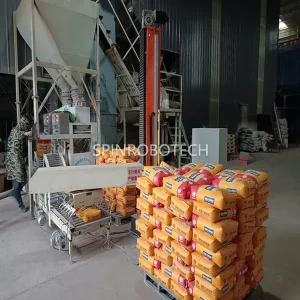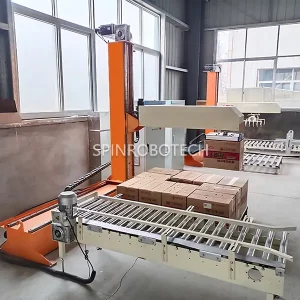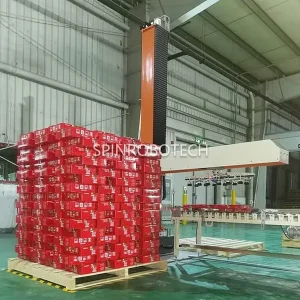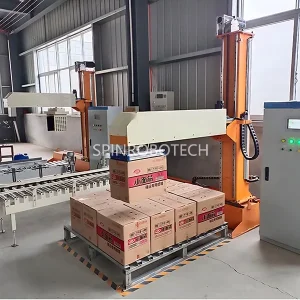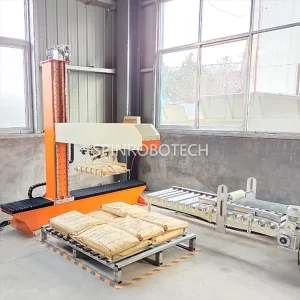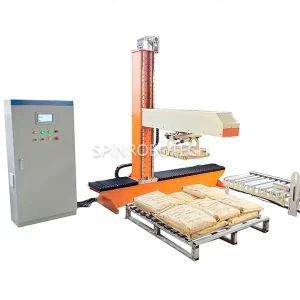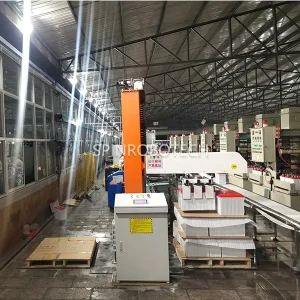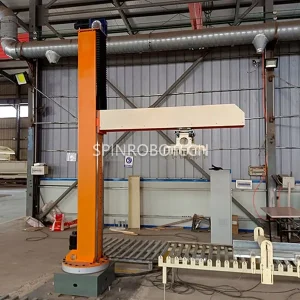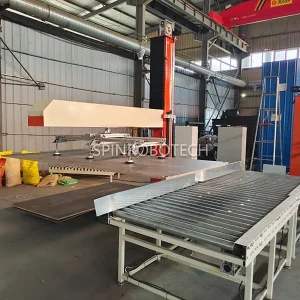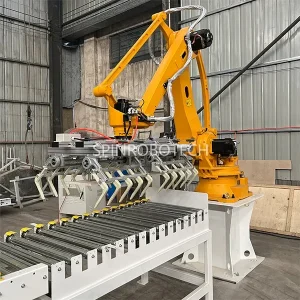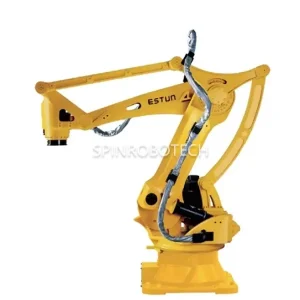


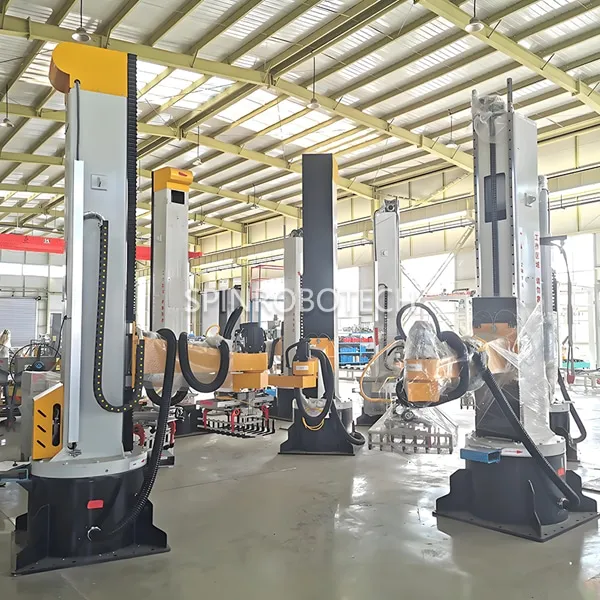
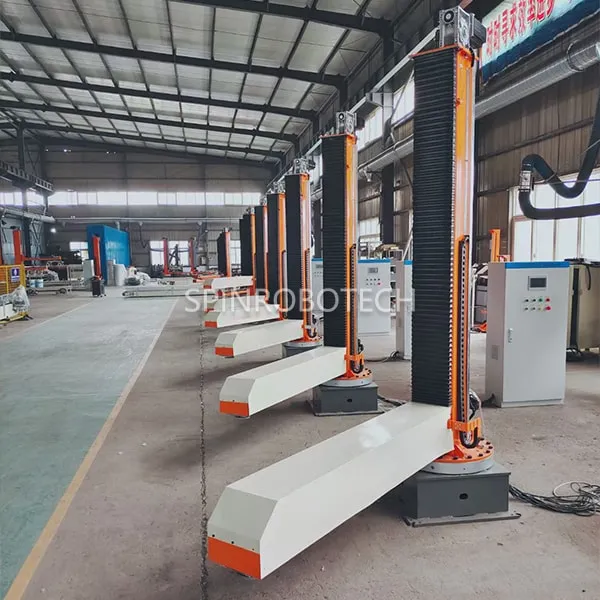

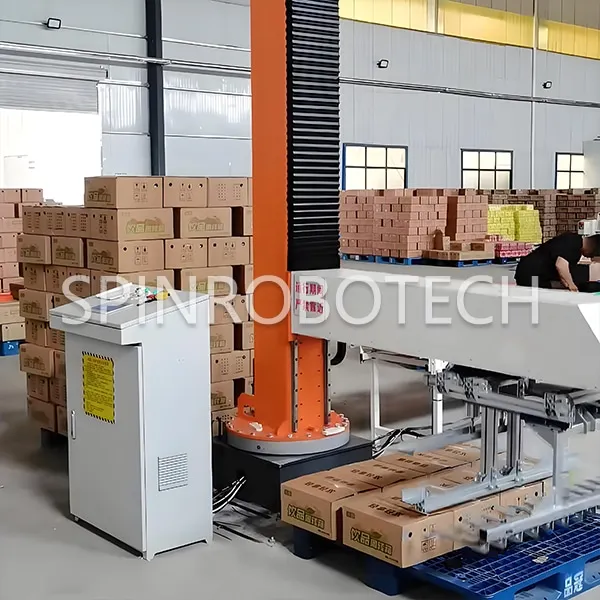
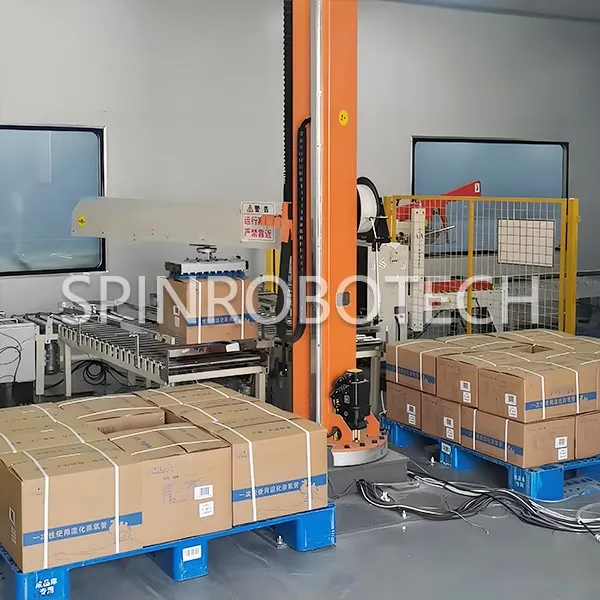

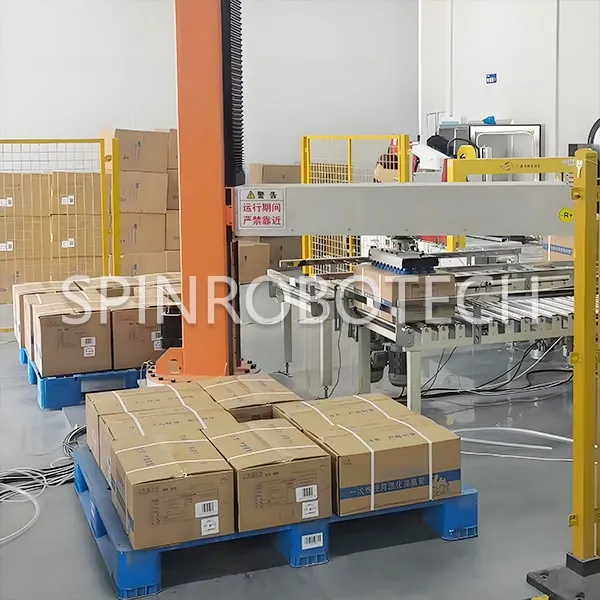
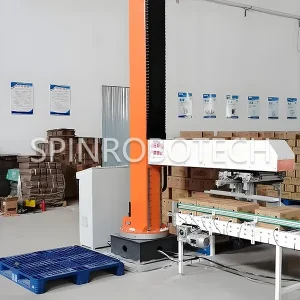
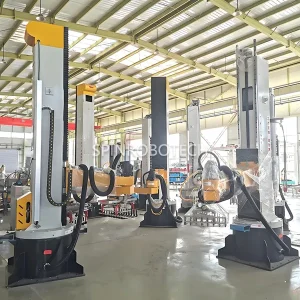
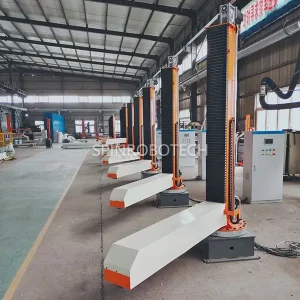

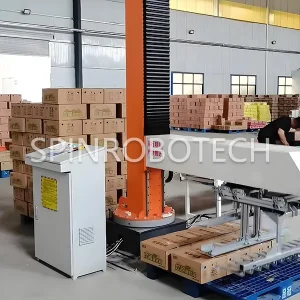
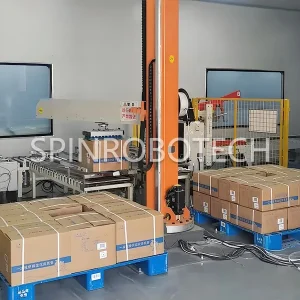
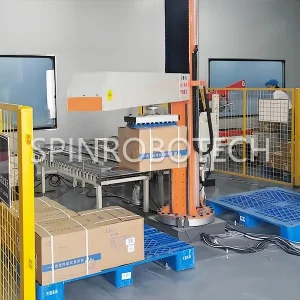
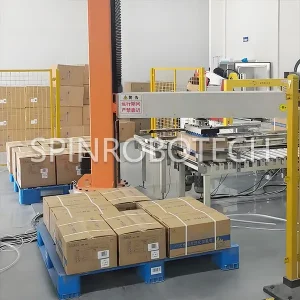
We Spin supply three mainstream palletizing robots: cartesian coordinate robots, column-type palletizer, and articulated robotic arms. For detailed information on the three palletizing machine types, click here: Automated Palletizing Solutions: A Complete Guide to Cartesian, Column-Type, and Articulated Robots
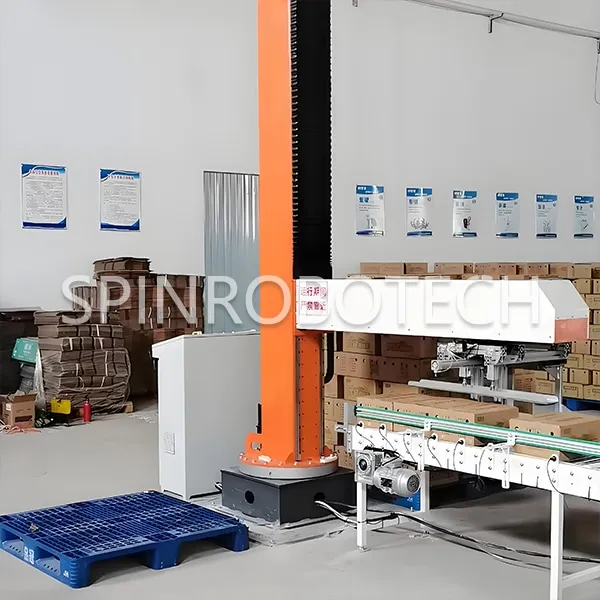
Column-type rotating automatic carton palletizer have become a mature and essential technology in the carton packaging industry. Their core value lies in automating processes to overcome the key pain points of manual palletizing – low efficiency, high costs, and intense physical labor – while their unique structural design is particularly well-suited to the diverse demands of carton production lines.
Typical Application Scenarios of Automatic Carton Palletizer:
-
Food & Beverage Industry: Palletizing milk, beverage, and beer cartons; capable of operating in cold storage environments.
-
Chemical & Building Materials Industry: Handling cartons containing chemicals or powders, minimizing human contact risks.
-
Logistics & Warehousing Centers: Efficiently managing the palletizing and depalletizing of multi-variety, small-batch orders to improve warehouse turnover rates.
-
Automotive & Parts Industry: Used for palletizing heavy parts (20-50kg) packed in cartons.
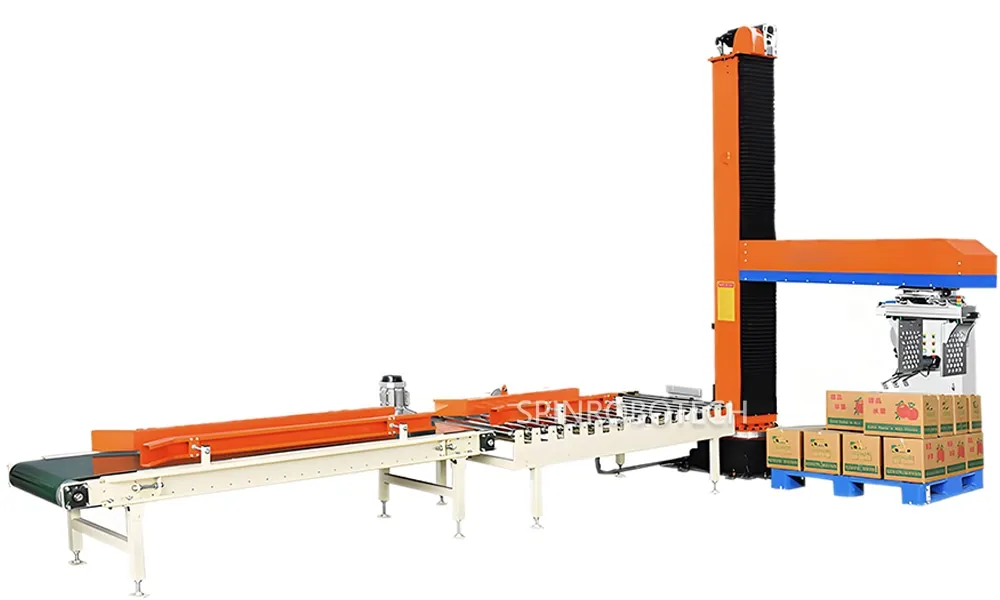
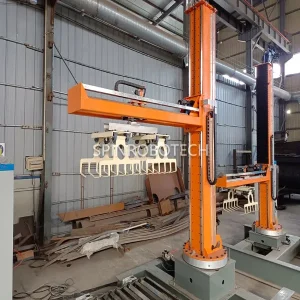
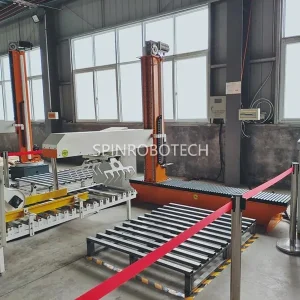
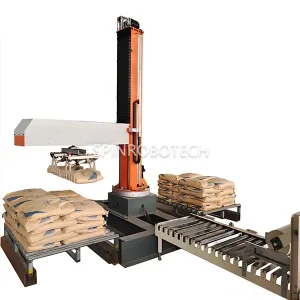
Automatic Column-type Palletizer: The Space-Saving Efficiency Experts
Column-Type Rotary Palletizing Robot, also known as a polar coordinate robot. It combines rotational and linear movements, and its structure typically consists of a base column (enabling rotation), an arm that can extend and retract vertically (enabling radial expansion and contraction), and an end effector.
For more single column palletizing robot system’s customer case, click here: Customer Case Study: How Three Types of Palletizing Robots Help Different Industries Achieve Automation Upgrade
Features:
-
Motion Method: Generally, comprises two types of motion:
-
Column rotation (θ-axis): The base drives the entire arm to rotate.
-
Radial extension (R-axis): The robot arm can extend forward or retract.
-
Vertical lifting (Z-axis): The end effector can move up and down.
Its motion trajectory covers any point within a cylindrical space centered on the column.
-
-
Load Capacity: Moderate load capacity, typically between that of Cartesian and articulated robots, making it suitable for medium-to-low load palletizing tasks.
-
Precision and Speed: Fast operation, smooth movement, and short cycle times.
-
Workspace: The workspace is a cylindrical sector area, striking a good balance between footprint and coverage range.
Advantages:
-
Small footprint (only one base) but large working range, offering extremely high space utilization.
-
High speed, short cycle times, and high efficiency.
-
Cost-effective, providing high value for money in suitable applications.
Typical Applications:
- Suitable for medium-to-low-speed palletizing production lines with a fan-shaped working area, compact space, and high cycle time requirements. Examples include palletizing bottled water, boxed beverages, food boxes, etc.
Robotic Palletizers VS Conventional Palletizers
Industry Applications of Palletizing Robot:
- Food & Beverage Industry: Our robotic arm palletizer efficiently handles cases, bottles, cans, and frozen goods while meeting strict hygiene standards.
- Pharmaceutical & Healthcare: Precision for medicine cartons & raw materials, medical devices, sterile packaging, fully GMP-compliant.
- Chemicals & Industrial Products: Stable for bags (powders, granules), drums, pails, and heavy containers, adaptable to various weights and formats.
- E-Commerce & Logistics Warehousing: Automated palletizing robot for Mixed-SKU palletizing, parcel sorting, warehouse automation.
- Building Materials & Heavy Manufacturing: Heavy-duty palletizers for cement bags, tiles, lumber, pipes, and construction materials.
- Automotive & Electronics: High-Speed palletizer for Engine parts, tires, fragile electronics, and components.

–What We Need from You:
-
3-5 samples of your typical packaging
-
Target throughput (pallets/hour)
-
Biggest pain point with current methods