
In simple terms, the core difference between conventional palletizers and robotic palletizers lies in flexibility and original design purpose.
Core Concept of Robotic Palletizers, Conventional Palletizers
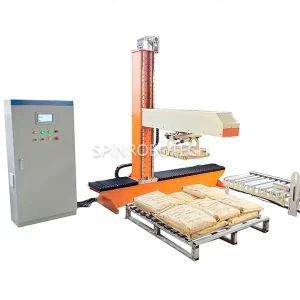
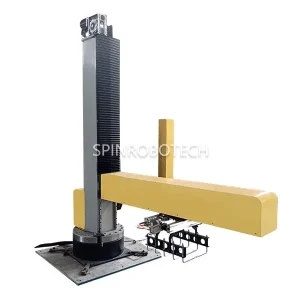
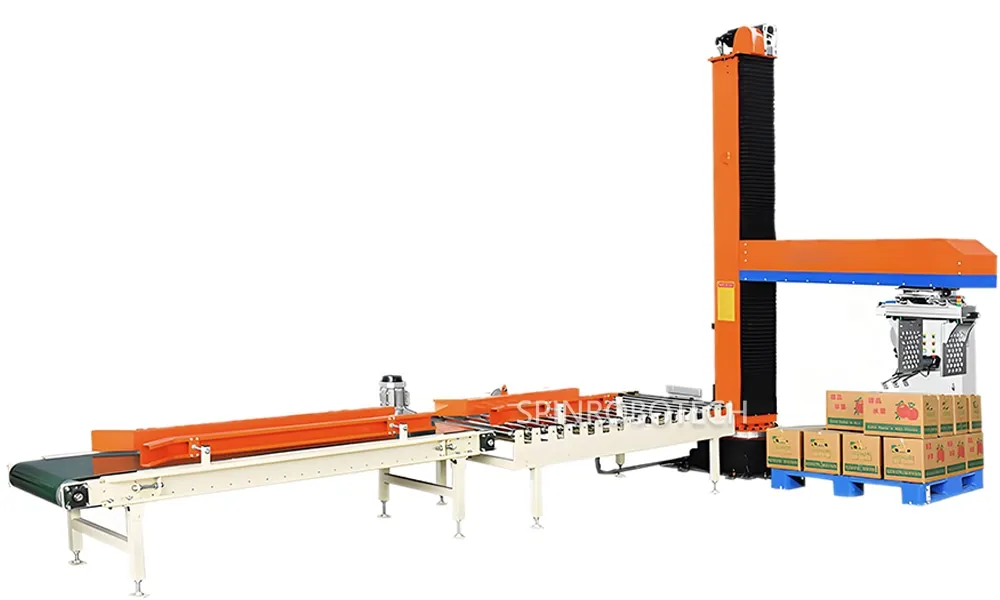
Conventional Palletizer: A dedicated machine designed for single, high-volume tasks. It’s like an efficient but “inflexible” assembly line worker.
Conventional palletizing machines offer a wide range of benefits for businesses. Perfect for high-speed and high-volume operations, ensuring quick efficient palletizing. They are also reliable, consistently producing stable and secure pallets, reducing the risk of product damage during transport or storage. Additionally, conventional palletizers enhance workplace safety by minimizing the need for manual handling of heavy loads, as the palletizing process is automated. These machines are adaptable and can be adjusted for various production requirements, providing flexibility in operations.
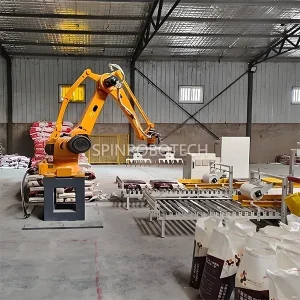
Robotic Palletizer: A flexible work cell consisting of an industrial robot arm, an end-of-arm tooling (EOAT – gripper, suction head, etc.), and an intelligent control system. It’s like a “versatile expert” to adapt to various tasks.
Robotic palletizing machines offer several advantages over conventional palletizing methods. They increase efficiency by working continuously without breaks, improve safety by reducing the risk of injuries associated with manual handling, and ensure consistent palletizing with each load. Robotic palletizers are also highly flexible, easily reprogrammable to handle different products and palletizing patterns, and they save space with their compact footprint. While the initial investment may be higher, the long-term cost savings from increased efficiency and reduced labor costs, make robotic palletizing machines a valuable investment for businesses looking to streamline their palletizing operations.
Articulated Palletizing Robots: The All-Rounder in Industrial Robotics
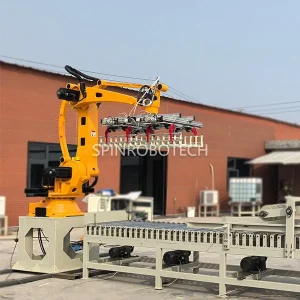

Detailed Comparison
| Conventional Palletizers | Robotic Palletizers | |
| Structure & Principle | Composed of fixed mechanical components (e.g., conveyors, layer formers, push plates, lifting tables). Relies on mechanical linkages to perform fixed sequences. | Core is a multi-axis industrial robot. Uses custom EOAT (suction, clamp, hook) and is controlled via programmed motion paths. |
| Flexibility | Very Low. After installment, the palletizing pattern (layer/stack), product size, and path are mostly fixed. Changing products or patterns typically requires mechanical adjustments or part changes, which is time-consuming and needs specialized personnel. | Very High. Can quickly switch between different products, patterns, and pallet sizes by reprogramming. A single robot line can easily handle multiple products, ideal for low-volume, high-mix flexible production. |
| Speed | Very High. Due to simple, direct, and simultaneous actions (e.g., pushing a whole layer), it often has a faster cycle time than robots when handling a single, stable product. | High. Speed depends on robot model and path optimization. May be slightly slower than top-tier conventional palletizers for continuous single-product runs, but can achieve very high speeds with optimized paths and dual-station setups. |
| Floor Space | Generally Larger. Requires longer conveyors for layer forming and accumulation. Layout is relatively fixed. | Generally More Compact. Install robot in a relatively small area, using its reach to cover a large workspace. Layout is more flexible. |
| Initial Investment | Generally Lower. Higher cost-effectiveness for single, high-volume standard products. | Generally Higher. The cost of the robot body, EOAT, and programming leads to a higher initial investment. |
| Long-term Cost & Maintenance | Maintenance is relatively straightforward, but there are many mechanical parts and wear items. Changeover costs for new products are high, potentially involving hardware modifications. | Maintenance requires more specialized knowledge (electrical, software), more standardized components. Key advantage: product changeovers incur almost no cost, only requiring a new program. |
| Spatial Requirements | Requires a stable product flow and sufficient linear space. | Less strict about infeed direction. Can pick and place from multiple directions within its workspace. |
Trend
Currently, robotic palletizing is the mainstream and growing market direction, driven by increasing demand for customization, low-volume batches, and quick changeovers. Conventional palletizers still hold an irreplaceable position in specific, stable bulk commodity sectors (e.g., beverages, building materials), but their market share is gradually declining.
Summary: The conventional palletizer is the “efficiency specialist,” while the robotic palletizer is the “versatile all-rounder.” In the era of Industry 4.0 and flexible manufacturing, the advantages of robotic palletizers are becoming increasingly prominent.
SPIN – Professional Palletizing Robot Solution Provider
Contact us for cost-effective automation equipment and expert technical support!