
In chemical, مواد البناء, or feed production workshops, the palletizing stage is often the most laborintensive bottleneck. Based on the actual site photos shared by the customer, let’s take an indepth look at how this equipment perfectly meets their needs.
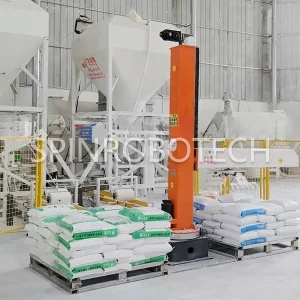
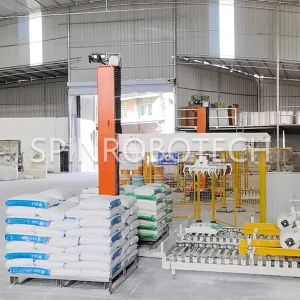
س1: Based on the site photos, what are the notable characteristics of the customer’s current production environment?
أ: This is a typical highceiling, multispecification bagged product workshop.
Diverse packaging:
The site handles both 20kg and 25kg bags, indicating a mixedproduct line.
Established upstream equipment:
Large storage hoppers and filling machines are present above, with custom roller conveyors below – the frontend automation foundation is already solid.
Space constraints vs. demand:
The plant has high ceilings, but the production line is densely packed; the palletizing area is actually quite limited, so we must choose equipment with a small footprint and high maneuverability.
Q2: Among many palletizing solutions, why do we prioritize the “column rotary” robot arm over traditional articulated robots?
أ: The key lies in space utilization و costeffectiveness.
Ultracompact:
Traditional articulated robots require a large safety rotation radius, whereas the column rotary palletizer has a vertical footprint of only 12 m² – perfectly suited to the tight line layout.
High costperformance:
For routine 2025 kg bag palletizing, the column robot’s load capacity and speed are fully adequate, yet its purchase and maintenance costs are far lower than those of a sixaxis industrial robot of the same capacity, significantly shortening the customer’s ROI cycle.
Low installation barriers:
Only need a simple floor foundation – no deep excavation needed – minimizing downtime for modifying the existing line.
س3: How important is the dualstation design in real production?
أ: Extremely important – this is the key configuration that determines overall palletizing efficiency.
أثناء العملية, once one side of the station is fully stacked, the arm automatically rotates to the other side to continue palletizing, while workers or forklifts seamlessly remove the full pallet and replace it with an empty one.
This design enables nonstop production, completely eliminating the idle time caused by waiting for forklift pallet changes in traditional singlestation machines, thereby greatly boosting daily output.
س 4: How do you handle the multivariety palletizing requirement shown in the photos?
أ: We have optimized the software strategy accordingly.
This column rotary palletizer features powerful teachin and recipe memory functions. The customer simply inputs different pickpoint coordinates, rotation angles, and stacking layers for 20kg and 25kg bags into the HMI. When the line switches product specifications, our system allow parameter changes within 1 minute – no complex mechanical modifications required. Truly “one machine for multiple uses.”
Q5: How is slipprevention and stacking regularity ensured for these bagged materials?
أ: In the site photos, the bottom layers are stacked very neatly – sides are flush, no bag sagging or misalignment.
This is achieved through our customized intelligent gripper, which adapts to the bag’s flatness for soft packaging of 20-25 kg and applies stable clamping force.
Coupled with the column’s high-precision servo rotation system, each bag placement deviation is controlled within millimeter accuracy, providing a solid foundation for subsequent stretch wrapping or direct outbound shipping.
ملخص
Why do we strongly recommend this dualstation column rotary palletizer to this customer – and to all customers in similar scenarios?
Because it delivers 24/7 dualstation operation within a minimal footprint, while simultaneously solving the pain point of mixedspec bagged lines. It is the optimal solution to help customers eliminate heavy manual labor and steadily increase productivity. If you have similar bagpalletizing needs for 2025 kg bags, feel free to reference this proven onsite solution!