

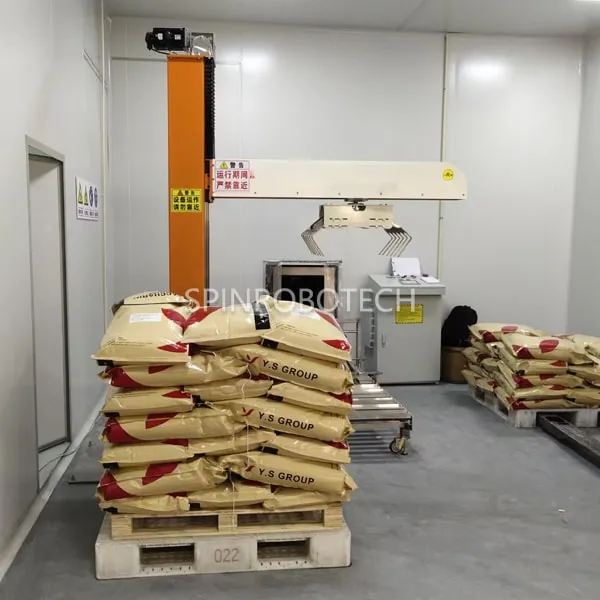
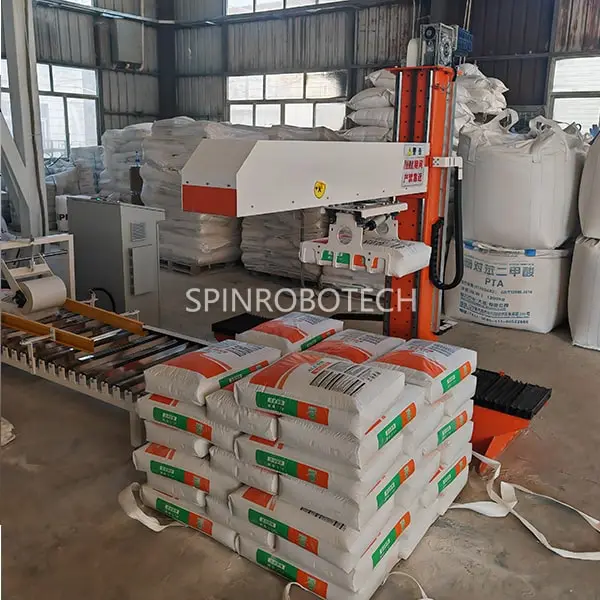


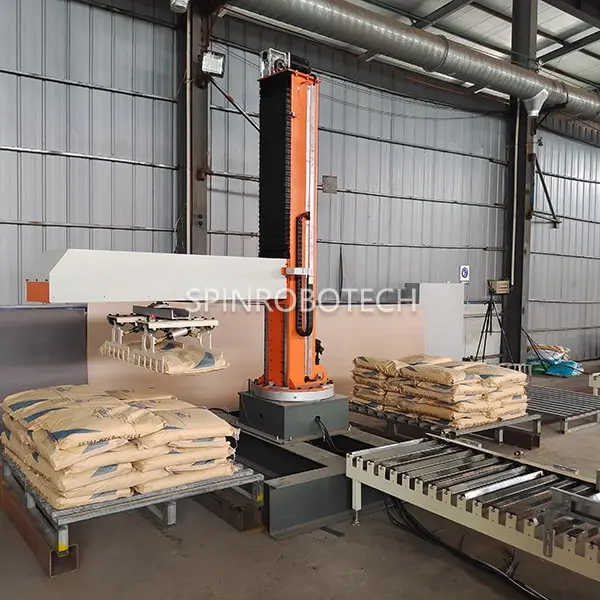


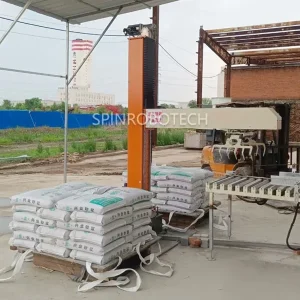
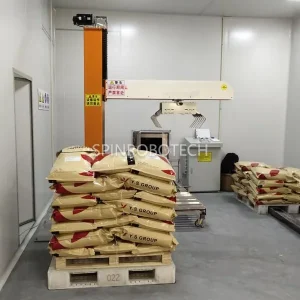
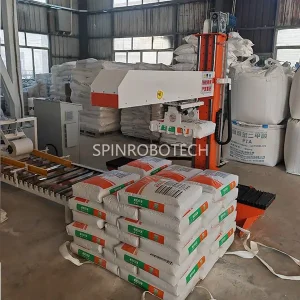
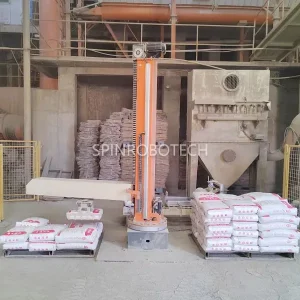


Why Bagged Products Need Dedicated Bag Palletizing Robot?
Automated Bag Palletizing Robot Solutions for Bagged Products: Precision Stacking, Zero Damage.
-
Zero-Bag-Damage Guarantee: Vacuum + mechanical combo (vs. 12% industry average)
-
Dynamic Alignment: Real-time bag position correction
-
Space Optimization: Compact design (10m²), retrofittable to existing lines
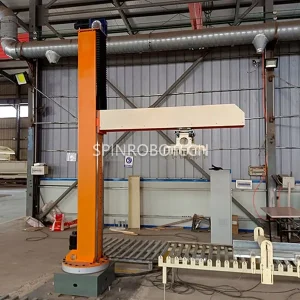
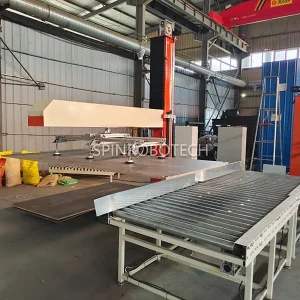
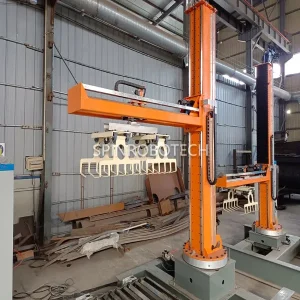
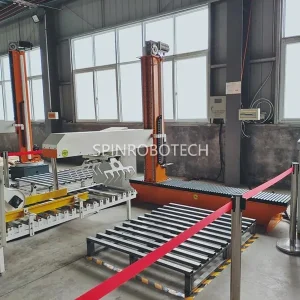
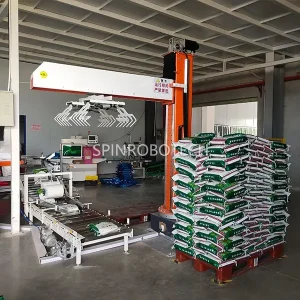
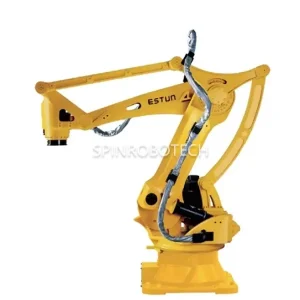
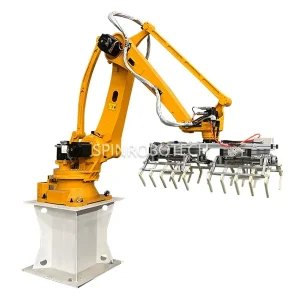
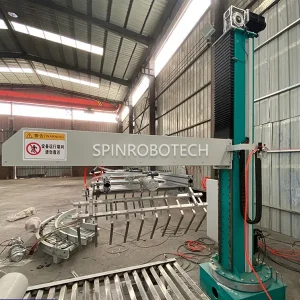
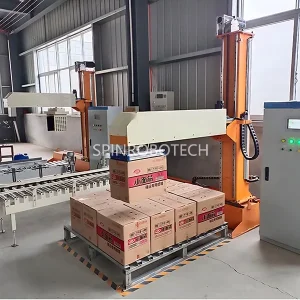
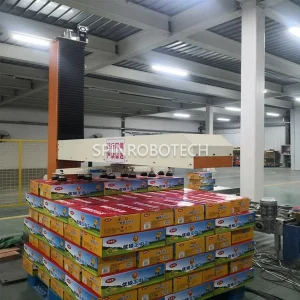
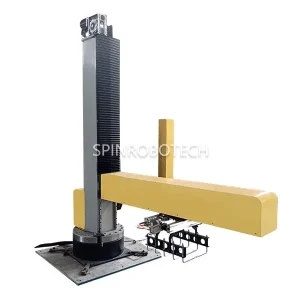
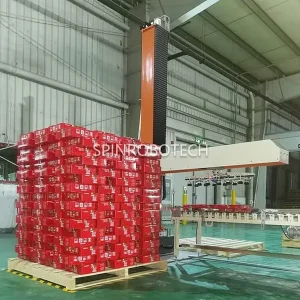
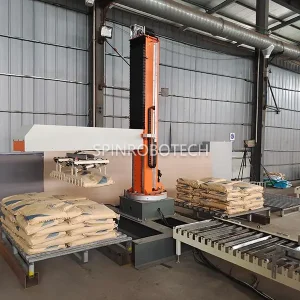
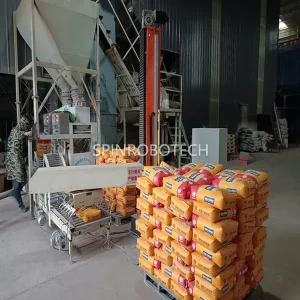
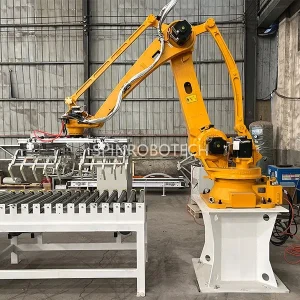
We Spin supplies three mainstream palletizing robots: cartesian coordinate robots, column-type rotary palletizer robots (also called polar coordinate robot), and articulated robotic arms. For detailed information on the three palletizing machine types, click here: Automated Palletizing Solutions: A Complete Guide to Cartesian, Column-Type, and Articulated Robots
Comparison of Advantages of Three Types of Robots in Bagged Product Palletizing
| Feature | Cartesian Robot | Column Rotary Robot | Articulated Robot (Multi-joint) |
| Core Advantage | Neat, Stable, Economical Pallets | Leading Speed, Space Saving | Ultimate Flexibility, Intelligent Adaptation |
| Stacking Quality | Excellent. Vertical lifting ensures proper bag posture, creating perfectly aligned and vertical stacks with the most stable structure. | Good. Maintains good stack shape even at high speeds, but rotational centrifugal force may require optimized control. | Excellent. Can mimic manual actions like “smoothing” and “gap-filling” to optimize the internal structure of the stack. |
| Operating Speed | Medium. Fixed motion path with steady acceleration, suitable for medium-high cycle rates (e.g., 400-700 bags/hour). | Very High. Point-to-point shortest path allows for fast action cycles, suitable for high-speed applications (600-1000+ bags/hour). | Low to Medium. Absolute cycle rate is often slower than Column Swing type due to more moving parts, but efficiency is compensated for by flexibility. |
| Space Occupancy | Large. Requires a gantry structure covering its entire workspace. | Minimal. Base rotation results in a small footprint and highest space utilization. | Medium. Requires consideration of the robot body and arm swing radius, typically needing safety fencing. |
| Load Capacity | Very Strong. Rigid structure suitable for heavy loads (e.g., 25-50kg+ bags). | Strong. Suitable for standard weight bagged products. | Model-dependent; heavy-duty models exist, but cost is higher for equivalent load capacity. |
| Flexibility | Low. Fixed programming, difficult to handle complex postures or temporary changes. | Medium. Can serve multiple pallets, but motion patterns are still primarily rotation and tilt. | Very High. Can handle bags of any incoming orientation, mixed production lines, and easily switch palletizing patterns. |
| Cost-Effectiveness | High. Relatively lowest initial investment and maintenance costs, offering outstanding value. | Medium. Falls between Cartesian and Articulated robots, a balance between performance and price. | Low. Highest initial investment, system integration, and maintenance costs. |
-
Cartesian coordinate robots are synonymous with “stability, precision, and efficiency” in the field of standardized product palletizing. They are particularly suitable for:
-
Large-scale production with relatively uniform product specifications.
-
Applications requiring extremely high neatness of the pallet.
-
Handling heavy and large-sized products.
-
Enterprises with limited budgets but in need of cost-effective automation solutions.
-
Regular workspaces that require easy-to-protect environments.
Their advantage lies in maximizing simple mechanical principles, achieving an unshakable position in the palletizing of standardized items through exceptional rigidity and precision.
2. Column-type rotary robots are the epitome of “speed, flexibility, and space efficiency.” They are particularly suitable for:
-
High-speed production lines with extremely high palletizing speed requirements.
-
Workshops with limited production space that require optimal space utilization.
-
Complex layouts where one robot needs to serve multiple points (production lines, pallets).
-
Handling standardized items such as bags, boxes, and drums.
-
Serving as a high-performance, cost-effective balanced solution between budget-friendly Cartesian robots and highly flexible articulated robots.
In summary, when your production line requires “swift, precise, and flexible” handling of large volumes of standardized items within limited space, the column-type rotary robot is often the optimal choice.
3. The robotic arm (multi-joint robot) represents the ultimate embodiment of “intelligence, flexibility, and versatility.” It is particularly suitable for:
-
Production lines with extremely diverse product types (high-mix, low-volume) requiring frequent changeovers.
-
Complex workspaces with obstacles that demand intricate motion paths.
-
Integrated workstations where palletizing needs to be combined with other processes (e.g., inspection, labeling, assembly, depalletizing).
-
Enterprises with high requirements for future scalability and adaptability of automation systems.
-
Handling irregularly shaped items or products requiring specific placement orientations.
In summary, when your production environment is dynamic, complex, and subject to future changes, investing in a robotic arm is akin to “purchasing insurance” for future competitiveness. It is not merely a tool for completing palletizing tasks but a strategic asset for building an intelligent, flexible, and adaptive production core.

Complete Guide to 6 Types of Palletizing Robot Grippers: Applications and Materials
Industry Applications of Palletizing Robots:
- Food & Beverage Industry: Our robotic arm palletizer efficiently handles cases, bottles, cans, and frozen goods while meeting strict hygiene standards.
- Pharmaceutical & Healthcare: Precision for medicine cartons & raw materials, medical devices, sterile packaging, fully GMP-compliant.
- Chemicals & Industrial Products: Stable for bags (powders, granules), drums, pails, and heavy containers, adaptable to various weights and formats.
- E-Commerce & Logistics Warehousing: Automated palletizing robot for Mixed-SKU palletizing, parcel sorting, warehouse automation.
- Building Materials & Heavy Manufacturing: Heavy-duty palletizers for cement bags, tiles, lumber, pipes, and construction materials.
- Automotive & Electronics: High-Speed palletizer for Engine parts, tires, fragile electronics, and components.
Start Your Customized Robotic Palletizer Journey
–What We Need From You:
-
3-5 samples of your typical packaging
-
Target throughput (pallets/hour)
-
Biggest pain point with current methods